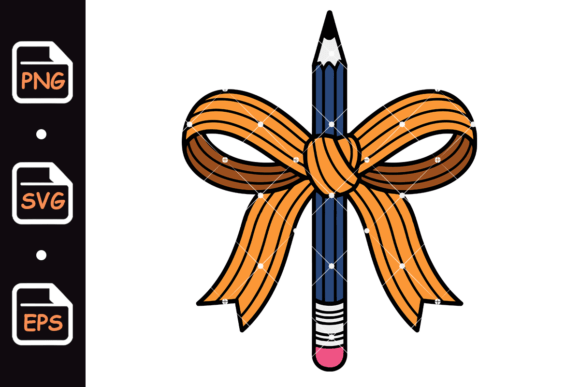
Pencil with Decorative Bow Illustration
A Soft, Thoughtful Touch for Handmade Charm
First glance at the Pencil with Decorative Bow Illustration lands softly—no sharp angles or aggressive lines, just gentle curves, a modest silhouette, and that sweet, slightly whimsical bow resting like a quiet accent above the eraser. It reads as thoughtful, not flashy; delicate, not fussy. As an embroidery designer who’s stitched hundreds of motifs for baby onesies, boutique aprons, and personalized teacher gifts, I immediately pictured this on a linen tea towel or a lightweight cotton tote—something meant to be held, used, and appreciated up close. It doesn’t shout. It invites.
Where This Design Truly Shines in Real Embroidery Projects
I recently prepped a small batch of custom embroidered sweatshirts for a local preschool teacher appreciation event—and the Pencil with Decorative Bow Illustration was my top contender. Why? Because it balances clarity and character at medium scale (roughly 3–4 inches wide). The pencil body holds clean satin stitch definition without excessive fill density, and the bow’s loops translate well into smooth, rounded satin columns when digitized properly. On a midweight french terry sweatshirt, it stitched cleanly with light tear-away stabilizer and standard 40-weight rayon thread. Customers responded warmly—not just to the motif itself, but to how *intentional* it felt. That matters: in handmade product markets, perceived care elevates perceived value.
It also works beautifully for baby embroidery—think onesies, burp cloths, or nursery wall hangings. The bow adds just enough visual interest without overwhelming tiny garments, and its open negative space helps prevent stiffness. For Etsy sellers listing personalized back-to-school bundles, this design pairs naturally with monogrammed initials or subtle “Future Artist” text—no overcomplication needed.
Where to Proceed with Intention (Not Caution)
This isn’t a “set-and-forget” motif for every surface. On highly textured fabrics—like bouclé knit or thick terry cloth—the bow’s fine curves can blur if stitch density isn’t adjusted. Likewise, on stretchy fabrics (think jersey tees), you’ll want to test hooping tension and consider a cut-away stabilizer underneath to keep those clean lines intact. And while the design scales down decently, avoid shrinking it below 2 inches wide for machine embroidery: the bow’s inner loop and pencil tip lose legibility, especially on dark fabric where thread coverage becomes critical.
Curved surfaces—like the front panel of a structured cap—require extra attention. The pencil’s straight profile handles curvature better than tightly coiled motifs, but the bow sits perpendicular to the grain. I’d recommend slight repositioning (tilting the bow 5–8°) or using a low-profile cap hoop to minimize distortion. Also, skip dense fill stitches in the bow unless your fabric can support it—opt instead for smooth satin columns with minimal underlay.
What It Adds to Your Finished Product—Beyond Aesthetics
The Pencil with Decorative Bow Illustration quietly strengthens brand consistency for creative entrepreneurs. Its tone is warm, inclusive, and quietly professional—ideal for educators, artists, stationery brands, or mindful lifestyle shops. Unlike overly cutesy or trend-driven graphics, it avoids dating quickly. That longevity supports repeat use across seasons: spring teacher gifts, summer camp merch, fall classroom decor, even holiday gift tags.
For craft fair vendors or small shop owners, this design improves buyer engagement because it feels *personalizable without being prescriptive*. You can embroider it solo as a standalone emblem—or layer it beside a name, date, or short phrase without visual competition. It doesn’t dominate; it complements. That flexibility translates directly to higher conversion on Etsy listings, especially when shown in realistic printable mockups on natural-light backgrounds.
Practical Designer Notes Before You Stitch
- Always test first—run a sample on scrap fabric matching your final project’s weight and texture. Check how the bow’s curves hold up and whether the pencil tip reads clearly.
- Review thread color contrast carefully. On dark fabric, a light thread may require an extra pass or denser satin stitch in the bow. On light fabric, matte pastels often read more softly—and more authentically—than high-sheen brights.
- Confirm hoop size compatibility. While the vector files (SVG, EPS) scale freely, your embroidery file must fit within your machine’s maximum hoop dimensions. Don’t assume automatic scaling preserves proportion or stitch integrity.
- Inspect small details in black-and-white mockups. Sometimes what looks balanced in color loses contrast or hierarchy in grayscale—critical for printed product photos or catalog use.
- Use proper stabilizer—lightweight cut-away for knits, tear-away for stable wovens, and optional topping for napped fabrics like fleece.
- Verify licensing terms before selling finished items or bundling the design into digital embroidery kits. The included SVG, Transparent PNG, and EPS files are versatile, but commercial use rights aren’t implied by format alone.
Final Thought: A Quietly Confident Choice
The Pencil with Decorative Bow Illustration won’t go viral—but it will earn repeat orders, thoughtful thank-you notes, and shelf space in curated boutiques. It’s the kind of illustration that makes a handmade product feel considered, not assembled. Whether you’re stitching for a client, building a craft business, or designing a limited-run collection, this motif earns its place not through novelty, but through quiet reliability. It fits the hand. It honors the material. And in a market flooded with loud, fast, and forgettable, that kind of restraint is rare—and valuable.